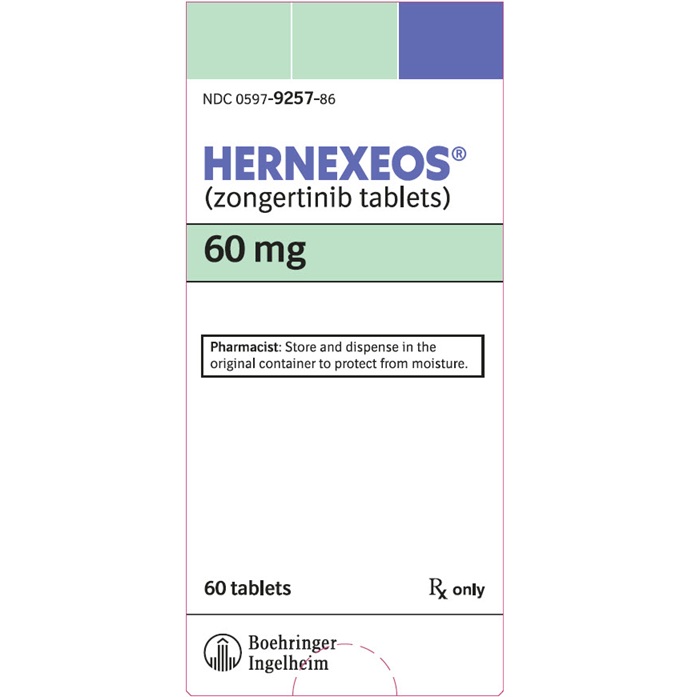
HERNEXEOS
Generic Name/API: zongertinib tablets
Manufacturer: Boehringer Ingelheim Pharmaceuticals
Dosage Forms & Strength & Pack Size:
Tablets: 60 mg, 60’s
Storage:
Store at 20°C to 25°C (68°F to 77°F), excursions permitted to 15°C to 30°C (59°F to 86°F) [see USP Controlled Room Temperature].
Store in the original container to protect from moisture. Keep the bottle tightly closed. Do not remove the desiccants. Once opened, use within 3 months. Discard any unused tablets 3 months after opening the bottle.
- INDICATION
- IMPORTANT SAFETY INFORMATION
What is HERNEXEOS?
HERNEXEOS is a prescription medicine used to treat adults with a type of lung cancer called non-squamous non-small
cell lung cancer (NSCLC) that:
– cannot be removed by surgery or that has spread to other parts of your body (metastatic), and
– has a certain mutation in the human epidermal growth factor receptor 2 (HER2) gene, and
– who have previously received treatment by mouth or injection (systemic therapy).
Your healthcare provider will perform a test to make sure HERNEXEOS is right for you.
It is not known if HERNEXEOS is safe and effective in children.
IMPORTANT SAFETY INFORMATION
Before taking HERNEXEOS, tell your healthcare provider about all of your medical conditions, including if you:
- have liver problems.
- have heart problems.
- have lung or breathing problems other than lung cancer.
are pregnant or plan to become pregnant. HERNEXEOS can harm your unborn baby.
Females who are able to become pregnant:
- Your healthcare provider will do a pregnancy test before you start treatment with HERNEXEOS.
- Use an effective form of birth control (contraception) during treatment with HERNEXEOS and for 2 weeks after your last dose.
- Talk to your healthcare provider about birth control methods that might be right for you during this time.
- Tell your healthcare provider right away if you become pregnant or think you are pregnant during treatment with HERNEXEOS.
- are breastfeeding or plan to breastfeed. It is not known if HERNEXEOS passes into your breastmilk. Do not breastfeed during treatment and for 2 weeks after your last dose of HERNEXEOS.
Tell your healthcare provider about all the medicines you take, including prescription and over-the-counter medicines, vitamins, and herbal supplements. HERNEXEOS may affect the way other medicines work, and other medicines may affect how HERNEXEOS works.
Know the medicines you take. Keep a list of them to show your healthcare provider or pharmacist when you get a new medicine.
What are the possible side effects of HERNEXEOS?
HERNEXEOS may cause serious side effects, including:
- liver problems. Liver problems are common with HERNEXEOS and can be severe and life-threatening. Your healthcare provider will do blood tests to check your liver function before you start taking HERNEXEOS and during your treatment. Tell your healthcare provider right away if you develop any signs and symptoms of liver problems, including:
- yellowing of your skin or the white part of your eyes (jaundice)
- dark or brown (tea colored) urine
- pain on the upper right side of your stomach area (abdomen)
- bleeding or bruising more easily than normal
- feeling very tired
- loss of appetite
- nausea or vomiting
- heart problems that may affect your heart’s ability to pump blood. HERNEXEOS can cause heart problems. Your healthcare provider will do tests to check your heart function before you start taking HERNEXEOS and during treatment. Tell your healthcare provider right away if you have any new or worsening symptoms of heart problems, including:
- feeling like your heart is pounding or racing
- dizziness
- tiredness
- feeling lightheaded
- shortness of breath
- loss of consciousness
- coughing
- swelling of your legs, ankles, or feet
- lung problems. HERNEXEOS can cause lung problems that are severe or life-threatening. Tell your healthcare provider right away if you have any new or worsening symptoms of lung problems, including trouble breathing, shortness of breath, cough, or fever.
Your healthcare provider may temporarily stop, decrease your dose, or permanently stop treatment with HERNEXEOS if you have serious side effects.
The most common side effects of HERNEXEOS include:
- diarrhea. HERNEXEOS can cause severe diarrhea. Tell your healthcare provider right away if you have diarrhea.
- liver problems
- rash
- feeling tired
- nausea
The most common severe abnormal blood tests include decreased white blood cell count, increased liver function tests, and decreased potassium levels.
HERNEXEOS may cause fertility problems in females and males, which may affect your ability to have children. Talk to your healthcare provider if this is a concern for you.
These are not all of the possible side effects of HERNEXEOS. Call your doctor for medical advice about side effects. For more information, ask your healthcare provider or pharmacist.
You are encouraged to report negative side effects of prescription drugs to the FDA. Visit www.fda.gov/medwatch or call 1‑800‑FDA‑1088.
*The contents of this site are for reference only. We do not offer drug procurement service. All information must not be used for any commercial purpose.