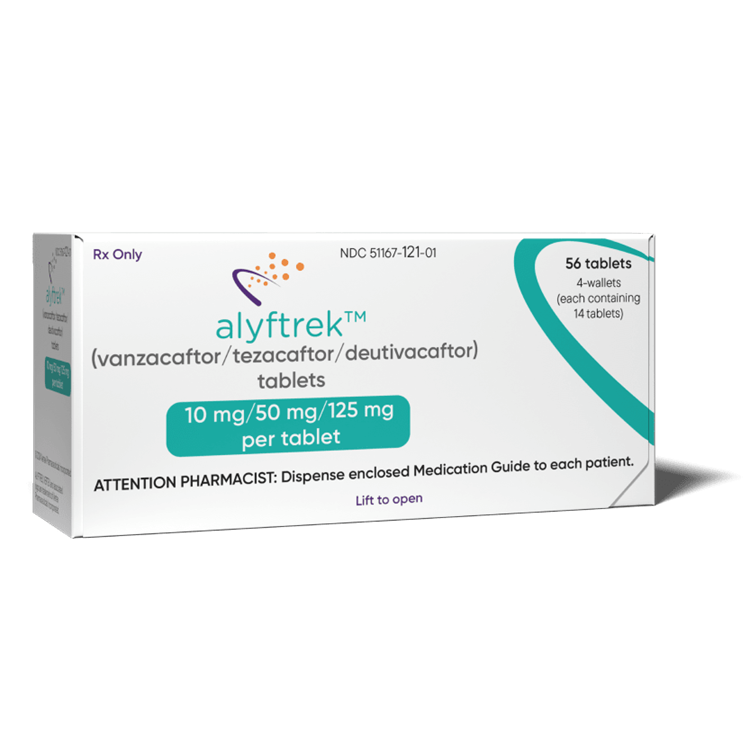
ALYFTREK
Generic Name/API: vanzacaftor, tezacaftor, and deutivacaftor tablets
Manufacturer: Vertex Pharmaceuticals Incorporated
Dosage Forms & Strength & Pack Size:
Tablets:
• Fixed-dose combination containing vanzacaftor 4 mg, tezacaftor 20 mg, and deutivacaftor 50 mg.
• Fixed-dose combination containing vanzacaftor 10 mg, tezacaftor 50 mg, and deutivacaftor 125 mg.
Storage:
Store at 20ºC – 25ºC (68ºF – 77ºF); excursions permitted to 15ºC – 30ºC (59ºF – 86ºF).
- INDICATION
- IMPORTANT SAFETY INFORMATION
ALYFTREK is a combination of deutivacaftor, a CFTR potentiator, tezacaftor, and vanzacaftor indicated for the treatment of cystic fibrosis (CF) in patients aged 6 years and older who have at least one F508del mutation or another responsive mutation in the CFTR gene.
If the patient’s genotype is unknown, an FDA-cleared CF mutation test should be used to confirm the presence of at least one indicated mutation.
WARNINGS AND PRECAUTIONS
Drug-Induced Liver Injury and Liver Failure Elevated transaminases have been observed in patients treated with ALYFTREK [Adverse Reactions (6.1)]. Cases of
serious and potentially fatal drug-induced liver injury and liver failure have been reported in patients with and without a history of liver disease who were taking a fixed-dose combination drug containing elexacaftor, tezacaftor, and ivacaftor (ELX/TEZ/IVA), which contains the same or similar active ingredients as ALYFTREK. Liver injury has been reported within the first month of therapy and up to 15 months following initiation of ELX/TEZ/IVA.
Assess liver function tests (ALT, AST, alkaline phosphatase, and bilirubin) in all patients prior to initiating
ALYFTREK. Assess liver function tests every month during the first 6 months of treatment, then every 3 months for the next 12 months, then at least annually thereafter. Consider more frequent monitoring in patients with a history of liver disease, elevated liver function tests at baseline, or a history of elevated liver function tests with drugs containing
ELX, TEZ and/or IVA. [see Dosage and Administration (2.4) and Use in Specific Populations (8.7)].
Interrupt ALYFTREK in the event of signs or symptoms of liver injury. These may include:
• Significant elevations in liver function tests (e.g., ALT or AST >5× the upper limit of normal (ULN) or ALT or AST >3× ULN with bilirubin >2× ULN)
• Clinical signs or symptoms suggestive of liver injury (e.g., jaundice, right upper quadrant pain, nausea, vomiting, altered mental status, ascites)
Consider referral to a hepatologist and follow patients closely with clinical and laboratory monitoring until
abnormalities resolve. If abnormalities resolve and if the benefit is expected to outweigh the risk, resume ALYFTREK treatment with close monitoring.
ALYFTREK should not be used in patients with severe hepatic impairment (Child-Pugh Class C). ALYFTREK is not recommended in patients with moderate hepatic impairment (Child-Pugh Class B) and should only be considered when there is a clear medical need, and the benefit outweighs the risk. If used, monitor patients closely [see Dosage and
Administration (2.4), Use in Specific Populations (8.7), and Clinical Pharmacology (12.3)].
5.2 Hypersensitivity Reactions, Including Anaphylaxis
Hypersensitivity reactions, including cases of anaphylaxis, have been reported in the postmarketing setting of drugs containing ELX, TEZ, and/or IVA (the same or similar active ingredients in ALYFTREK). If signs or symptoms of serious hypersensitivity reactions develop during ALYFTREK treatment, discontinue ALYFTREK and institute appropriate therapy. Consider the benefits and risks for the individual patient to determine whether to resume treatment with ALYFTREK.
5.3 Patients Who Discontinued or Interrupted Elexacaftor-, Tezacaftor-, or Ivacaftor-Containing Drugs
Due to Adverse Reactions
There are no available safety data for ALYFTREK in patients who previously discontinued or interrupted treatment with drugs containing elexacaftor, tezacaftor, or ivacaftor due to adverse reactions. Consider the benefits and risks
6
before using ALYFTREK in these patients. If ALYFTREK is used in these patients, closely monitor for adverse reactions as clinically appropriate.
before using ALYFTREK in these patients. If ALYFTREK is used in these patients, closely monitor for adverse
reactions as clinically appropriate.
5.4 Reduced Effectiveness with Concomitant Use with CYP3A Inducers
Following concomitant use of strong or moderate CYP3A inducers with ALYFTREK, exposures of vanzacaftor, tezacaftor, and deutivacaftor were decreased, which may reduce ALYFTREK effectiveness. Concomitant use with strong or moderate CYP3A inducers is not recommended [see Drug Interactions (7.1)].
5.5 Adverse Reactions with Concomitant Use with CYP3A Inhibitors
Following concomitant use of strong or moderate CYP3A inhibitors with ALYFTREK, exposures of vanzacaftor, tezacaftor, and deutivacaftor were increased, which may increase the risk of ALYFTREK-associated adverse reactions.
Reduce the ALYFTREK dosage with concomitant use of strong or moderate CYP3A inhibitors [see Dosage and
Administration (2.3) and Drug Interactions (7.1)].
5.6 Cataracts
Cases of non-congenital lens opacities have been reported in pediatric patients treated with drugs containing ivacaftor (which is similar to an active ingredient in ALYFTREK). Although other risk factors were present (such as corticosteroid use, exposure to radiation) in some cases, a possible risk attributable to ivacaftor treatment cannot be excluded. Baseline and follow-up ophthalmological examinations are recommended in pediatric patients treated with ALYFTREK [see Use in Specific Populations (8.4)].
*The contents of this site are for reference only. We do not offer drug procurement service. All information must not be used for any commercial purpose.