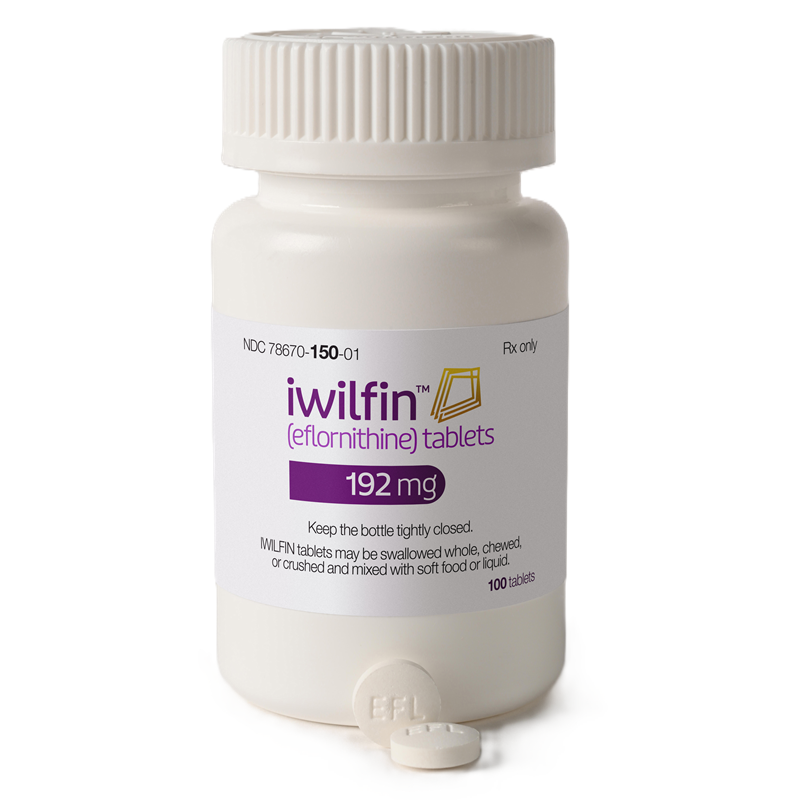
IWILFIN
Generic Name/API: eflornithine
Manufacturer: USWM
Dosage Forms & Strength & Pack Size:
Tablets: 192 mg, 100’s
Storage:
Store at room temperature, 20°C to 25°C (68°F to77°F), excursions permitted between 15°C to 30°C (59°F to 86°F) [see USP Controlled Room Temperature].
- INDICATION
- IMPORTANT SAFETY INFORMATION
WHAT IS IWILFIN?
IWILFIN is a prescription medicine used to reduce the risk of relapse in adults and children with high-risk neuroblastoma (HRNB) who have had at least a partial response to certain prior therapies.
IMPORTANT SAFETY INFORMATION
Before you take IWILFIN, tell your healthcare provider about your medical conditions, including if you have hearing problems, if you are pregnant or may become pregnant, or if you are breastfeeding.
If you or your partner are able to become pregnant, use effective birth control during treatment with IWILFIN and for 1 week after the last dose. Tell your healthcare provider right away if you or your partner become pregnant during treatment. Do not breastfeed during treatment with IWILFIN and for 1 week after the last dose.
IWILFIN can cause low blood cell counts. Tell your healthcare provider right away if you develop symptoms of low blood cell counts, including fever, easy bruising or bleeding, blood in your urine or stool, feeling unusually tired or weak, shortness of breath, or chills or shivering.
IWILFIN can cause liver problems. Tell your healthcare provider right away if you develop symptoms of liver problems, including your skin or white of your eyes turning yellow; dark urine; light-colored stools; nausea or vomiting; easy bruising or bleeding; loss of appetite; or pain, aching, or tenderness on the right side of your abdomen.
Hearing loss is common during treatment with IWILFIN and can be serious. Some people have needed to use hearing aids. Tell your healthcare provider right away if you get ringing in your ears or any new or worsening hearing loss.
What are the possible side effects of IWILFIN?
The most common side effects of IWILFIN in Study 3b included ear infection; diarrhea; cough; sinus infection; pneumonia; upper respiratory tract infection; pink eye; vomiting; stuffy, runny, itchy nose or sneezing; fever; skin infection; and urinary tract infection.
*The contents of this site are for reference only. We do not offer drug procurement service. All information must not be used for any commercial purpose.