OJEMDA
Generic Name/API: tovorafenib
Manufacturer: Day One Biopharmaceuticals, Inc.
Dosage Forms & Strength & Pack Size:
Tablets: 100 mg
For Oral Suspension: 25 mg/mL
Storage:
OJEMDA tablets:
100 mg: orange, film-coated, oval tablets debossed with “100” on one side and “D101” on the opposite side and
supplied as follows:
4 blister cards (4 tablets each) per box, NDC 82950-001-16.
5 blister cards (4 tablets each) per box, NDC 82950-001-20.
4 blister cards (6 tablets each) per box, NDC 82950-001-24.
Store at 20°C to 25°C (68°F to 77°F); excursions permitted between 15°C to 30°C (59°F to 86°F) [see USP
Controlled Room Temperature].
Dispense product in the original package. Tablets should not be removed from blisters until immediately before
use.
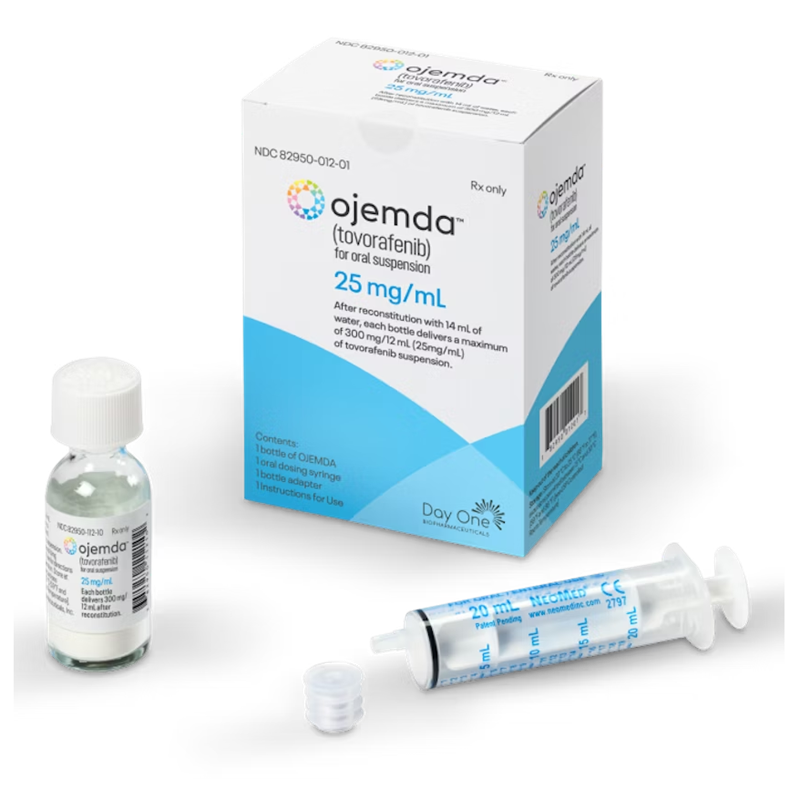
OJEMDA for oral suspension:
25 mg/mL: white to off white powder in a clear glass bottle, co-packaged with a press-in bottle adaptor and a 20
mL oral dosing syringe (NDC# 82950-012-01).
Each mL of reconstituted, strawberry flavored tovorafenib suspension contains 25 mg of tovorafenib. Each
bottle delivers 300 mg of tovorafenib in 12 mL.
Store at 20°C to 25°C (68°F to 77°F); excursions permitted between 15°C to 30°C (59°F to 86°F) [see USP
Controlled Room Temperature].
Do not use if safety seal under cap is broken or missing.
Suspension must be used immediately after reconstitution.
Discard the bottle (including any unused portion) and syringe after dosing.
- INDICATION
- IMPORTANT SAFETY INFORMATION
What is OJEMDA™ (tovorafenib)?
OJEMDA is a prescription medicine used to treat certain types of brain tumors (cancers) called gliomas in patients 6 months and older:
- that is a pediatric low-grade glioma (LGG), and
- that has come back after previous treatment or has not responded to previous treatment and
- that has a certain type of abnormal “BRAF” gene.
Before taking or giving OJEMDA, tell your healthcare provider about all of your or your child’s medical conditions, including if you:
- have bleeding, skin, or liver problems
- are pregnant or plan to become pregnant. OJEMDA can harm your unborn baby.
Females who are able to become pregnant:
- You should use effective non-hormonal birth control (contraception) during treatment with OJEMDA and for 28 days after your last dose of OJEMDA.
Males with female partners who are able to become pregnant should use effective non-hormonal birth control (contraception) during treatment with OJEMDA and for 2 weeks after your last dose of OJEMDA.
- are breastfeeding or plan to breastfeed. Do not breastfeed during treatment and for 2 weeks after your last dose of OJEMDA.
Tell your healthcare provider about all the medicines you take, including prescription and over-the-counter medicines, vitamins, and herbal supplements.
What should I avoid while taking OJEMDA?
Limit the amount of time you spend in sunlight. OJEMDA can make your skin sensitive to the sun (photosensitivity). Use sun protection measures, such as sunscreen, sunglasses and wear protective clothes that cover your skin during your treatment with OJEMDA.
What are the possible side effects of OJEMDA?
OJEMDA may cause serious side effects, including:
- bleeding problems (hemorrhage) are common and can also be serious. Tell your healthcare provider if you develop any signs or symptoms of bleeding, including:
- headache, dizziness or feeling weak
- coughing up blood or blood clots
- vomiting blood or your vomit looks like “coffee grounds”
- red or black stools that look like tar
- skin reactions, including sensitivity to sunlight (photosensitivity). OJEMDA can cause skin reactions that can become severe. Tell your healthcare provider if you get new or worsening skin reactions, including:
- rash
- bumps or tiny papules
- acne
- peeling, redness, or irritation
- blisters
- liver problems. Your healthcare provider will do blood tests to check your liver function before and during treatment with OJEMDA. Tell your healthcare provider right away if you develop any of the following symptoms:
- yellowing of your skin or your eyes
- dark or brown (tea-colored) urine
- nausea or vomiting
- loss of appetite
- tiredness
- bruising
- bleeding
- pain in your upper right stomach area
- slowed growth in children. Growth will be checked routinely during treatment with OJEMDA.
The most common side effects of OJEMDA include:
- rash
- hair color changes
- tiredness
- viral infection
- vomiting
- headache
- fever
- dry skin
- constipation
- nausea
- acne
- upper respiratory tract infection
OJEMDA may cause fertility problems in males and females, which may affect your ability to have children.
*The contents of this site are for reference only. We do not offer drug procurement service. All information must not be used for any commercial purpose.