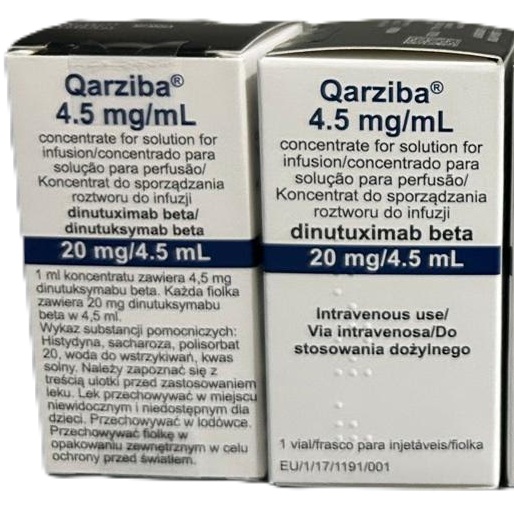
QARZIBA
Generic Name/API: dinutuximab beta
Manufacturer: EUSA Pharma
Dosage Forms & Strength & Pack Size:
4.5 mg/mL concentrate for solution for infusion
Storage:
Keep this medicine out of the sight and reach of children.
Do not use this medicine after the expiry date which is stated on the label and the carton after EXP. The expiry date refers to the last day of that month.
Store in a refrigerator (2 °C – 8 °C). Keep the vial in the outer carton in order to protect from light.
Once opened, Qarziba is intended for immediate use.
- INDICATION
- IMPORTANT SAFETY INFORMATION
What Qarziba is and what it is used for
Qarziba contains dinutuximab beta, which belongs to a group of medicines called ‘monoclonal antibodies’. These are proteins, which specifically recognise and bind to other unique proteins in the body. Dinutuximab beta binds to the molecule known as disialoganglioside 2 (GD2), which is present on cancer cells, and this activates the body’s immune system, causing it to attack the cancer cells.
Qarziba is used to treat neuroblastoma that has a high risk of coming back after a series of treatments, which include a stem cell transplantation for rebuilding the immune system. It is also used to treat neuroblastoma that has come back (relapsed) or could not be completely treated with previous therapies.
Prior to the treatment of relapsed neuroblastoma, your treating physician will stabilise any actively progressing disease by other suitable measures.
Your doctor will further decide whether the co-administration of a second medicine, interleukin-2, is necessary for the treatment of your cancer.
Neuroblastoma is a type of cancer that grows from abnormal nerve cells in the body, in particular in the glands above the kidneys. It is one of the most common cancers in infancy.
It is used for patients aged 12 months and above.
Warnings and precautions
Before receiving Qarziba, you will have blood tests to check your liver, lung, renal and bone marrow functions.
You might notice the following when you first receive Qarziba and during the course of treatment:
•
pain
Pain is one of the most common side effects of Qarziba. It usually occurs at the beginning of infusion. Therefore, your doctor will give you an appropriate pain treatment starting 3 days before and continuing during use of Qarziba.
•
allergic reactions or other infusion-related reactions
Tell your doctor or nurse if you have any kind of reaction during or after the infusion, such as:
– fever, shivering and/or low blood pressure
– difficulties in breathing
– skin rash, hives
You will receive appropriate treatment to prevent these reactions and be closely monitored for these symptoms during infusion of Qarziba.
•
leakage from small blood vessels (capillary leak syndrome)
Leakage of blood components from small blood vessels may cause rapid swelling in arms, legs and other parts of the body. Rapid drop in blood pressure, light-headedness and breathing difficulties are further signs.
•
eye problems
You may notice changes to your vision.
•
problems with your nerves
You may notice numbness, tingling or burning in your hands, feet, legs or arms, reduced sensation or weakness with movement.
•
spinal cord and brain problems (central nervous system, CNS)
Tell your doctor or nurse if you have any kind of CNS symptoms, such as: substantial prolonged neurological deficit without apparent reason such as muscle weakness or loss of muscle strength in the legs (or arms), or mobility problems or unusual sensations and numbness, persistent or sudden onset of a headache, or progressive loss of memory and cognitive ability, subtle personality changes, inability to concentrate, lethargy, and progressive loss of consciousness.
*The contents of this site are for reference only. We do not offer drug procurement service. All information must not be used for any commercial purpose.